.jpg)
NASA Is Sending an AI Robot to Grab a Piece of Saturn's Rings
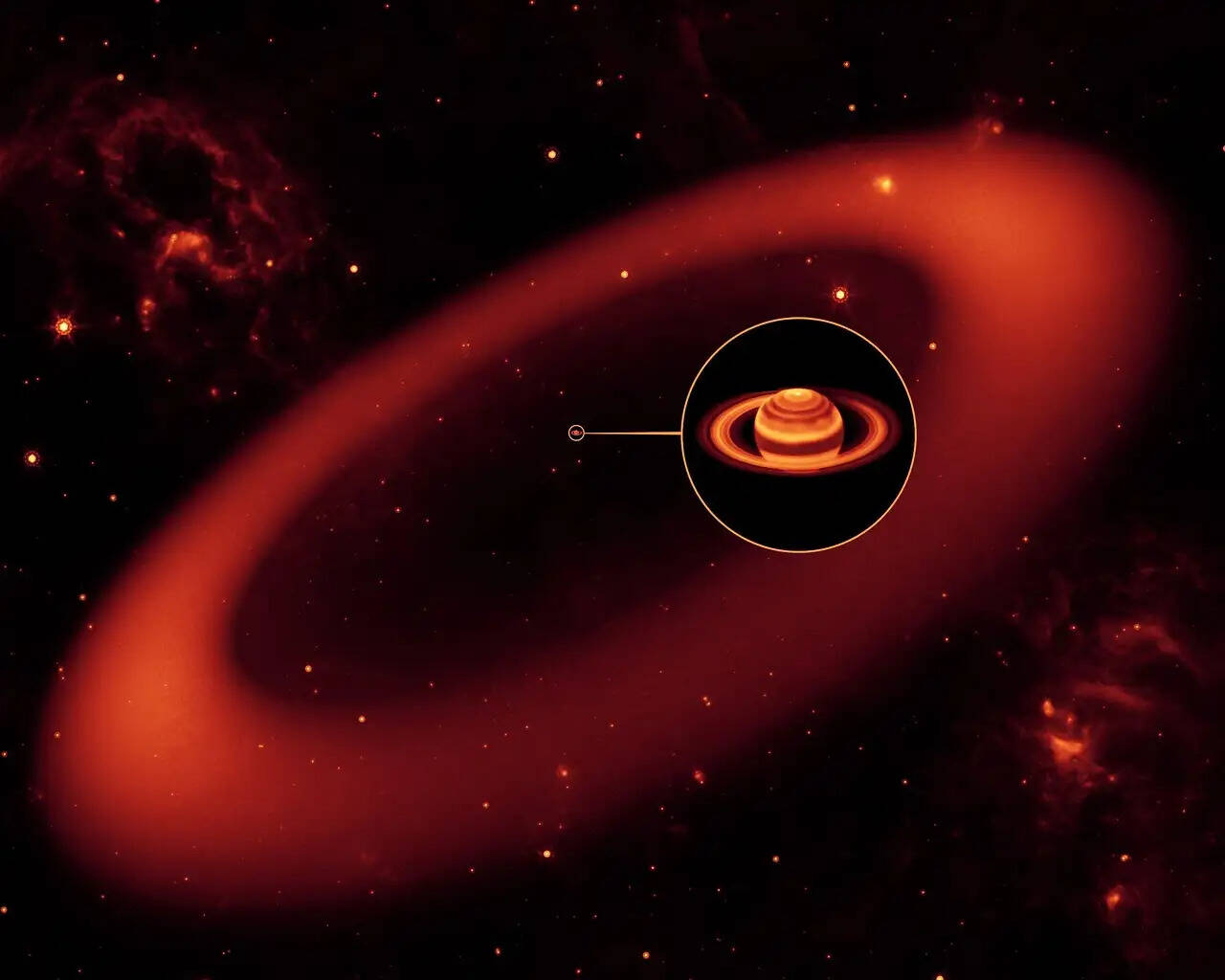
For decades, everything scientists have learned about Saturn's rings has come from a distance — images, spectral readings, and remote observations, but never an actual physical sample.
NASA now has a concept mission that could finally change that, using an AI-powered robotic system to reach out and touch the rings directly for the first time.
Meet PRAXIS
The mission is called PRAXIS, short for Planetary Rings Autonomous EXploration with In-situ Sampling.
It received Phase I funding from NASA's Innovative Advanced Concepts (NIAC) program in March 2026 — an early-stage award that supports ambitious ideas with the potential to reshape future aerospace technology, though it's worth noting this places PRAXIS at a conceptual and feasibility-study stage rather than a confirmed, funded mission ready for launch.
If it moves forward through later development stages, PRAXIS would perform the first-ever in-situ sampling of planetary ring particles, collecting real physical material instead of relying solely on distant imaging and remote sensing, as every prior Saturn mission — including the Voyager probes and the long-running Cassini orbiter — has had to do.
Why AI Is Central to the Mission
Saturn sits roughly 1.4 billion kilometers from Earth, a distance that introduces a significant communication delay between mission control and any spacecraft operating there.
That lag makes real-time, manual control of delicate maneuvers essentially impossible — by the time a command reaches the spacecraft, conditions may have already changed.
PRAXIS is designed to solve this by putting an AI-powered robotic arm, attached to a long deployable boom, in charge of the actual sampling process.
The system would allow the spacecraft to briefly approach the rings, collect particles, and safely retreat, all without colliding with the ring structure — split-second decisions made autonomously onboard, rather than relayed back and forth across more than a billion kilometers of space.
What the Spacecraft Would Actually Collect
Saturn's rings are made primarily of water ice mixed with dust and rocky material, with particle sizes ranging dramatically — from microscopic grains to boulders as large as houses.
PRAXIS's touch-and-go sampling system is expected to gather particles in the millimeter-to-centimeter range, small enough to collect safely, but large enough to yield meaningful data once analyzed by onboard scientific instruments.
The mission concept calls for sampling from multiple distinct regions of the ring system, rather than a single location, to build a broader picture of how composition and structure vary across the rings.
The Scientific Questions PRAXIS Hopes to Answer
Despite decades of study, Saturn's rings still leave researchers with real, unresolved questions: how the rings originally formed, how they've evolved since, and how individual particles interact with one another within the system.
Physical samples — rather than remote spectral analysis alone — would let scientists directly measure particle size, composition, porosity, and structure, offering a far more precise picture than imaging can provide on its own.
There's also a broader payoff beyond Saturn itself. Because ring systems around other planets, including Uranus and Neptune, are thought to share underlying formation processes, insights gained from Saturn's rings could help scientists better understand these more distant, less-studied ring systems as well.
Building on Cassini's Legacy
PRAXIS would pick up where Cassini left off. NASA's Cassini spacecraft spent 13 years orbiting Saturn, including a series of daring dives through the gap between the planet and its rings before its planned atmospheric plunge in September 2017.
Cassini transformed scientific understanding of Saturn from a distance — but even at its closest, it never physically touched the rings themselves. PRAXIS represents the natural next step: moving from observation to direct, hands-on sampling.
Where the Mission Stands Now
As a NIAC Phase I concept, PRAXIS is currently in the stage of mission planning, computer simulation, engineering design, and feasibility studies. Only the most promising NIAC concepts advance to further development and eventual funding for an actual mission, so PRAXIS's timeline toward a real launch remains uncertain.
Still, the concept represents a notable direction in modern space exploration more broadly: growing reliance on autonomous, AI-driven systems to operate safely in environments too distant and too complex for real-time human control.
The Takeaway
If PRAXIS eventually launches, it would mark a genuine first in planetary science — direct physical contact with one of the solar system's most iconic and least understood structures. For now, it stands as an early but ambitious concept, another sign of how central artificial intelligence is becoming to the next generation of deep space exploration.
