.jpg)
The Shark That Lives for 400 Years
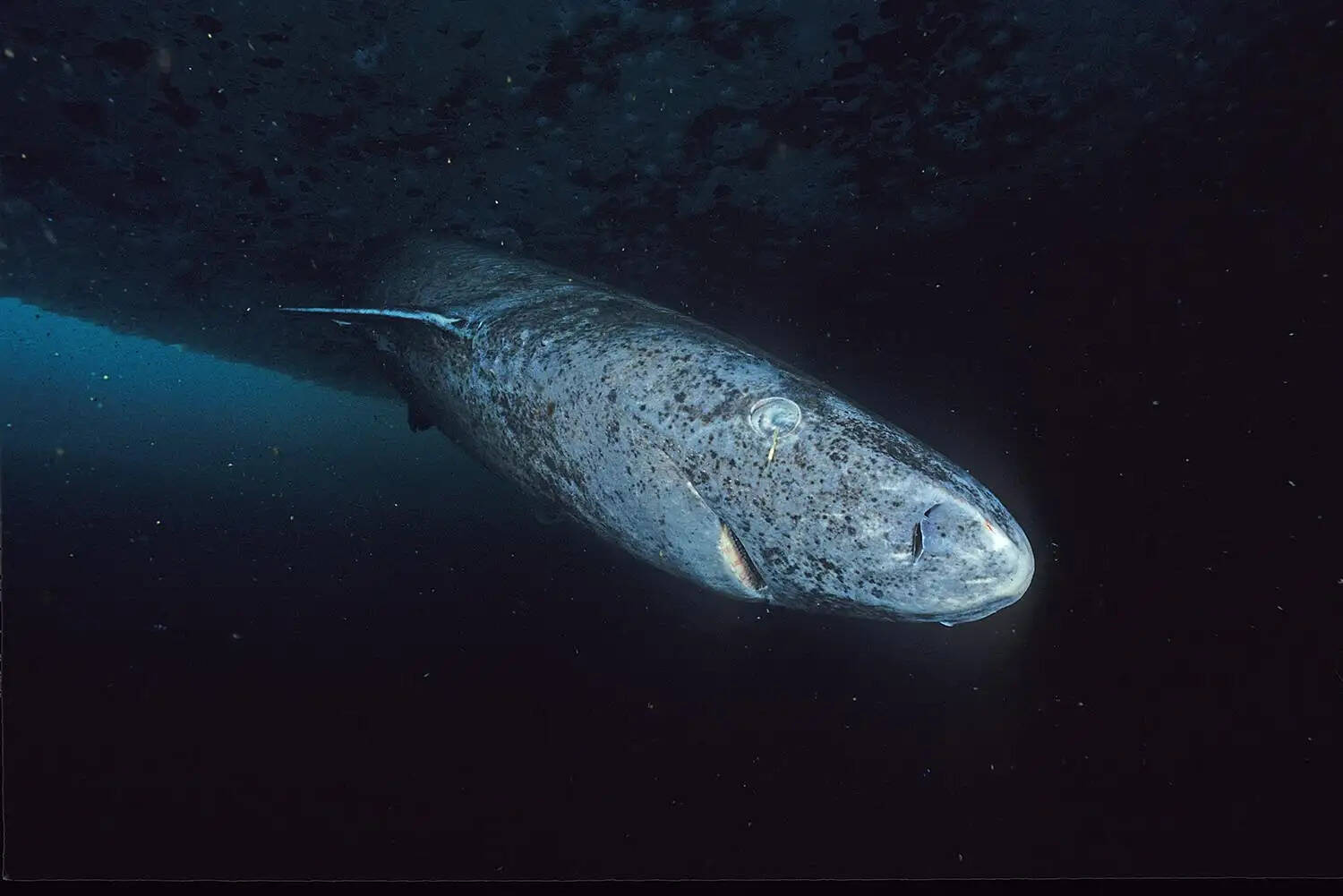
Somewhere in the frigid depths of the North Atlantic, there may be a shark alive today that was already swimming when the Great Plague swept through London in 1665. That's not an exaggeration — it's the real, scientifically estimated lifespan of the Greenland shark, the longest-living vertebrate known on Earth.
Meet the Greenland Shark
The Greenland shark (Somniosus microcephalus) is a massive, slow-moving predator, typically growing to 4 to 5 meters in length, that inhabits some of the coldest, deepest waters on the planet — from the North Atlantic to the Arctic Ocean, at depths approaching 3,000 meters and temperatures as low as -1.1°C.
Despite its name, it isn't confined to Greenland's waters alone; the species has been recorded as far away as the western Caribbean. Because it lives in such extreme, hard-to-study environments, it remains far less understood than most of the more than 500 other known shark species.
How Scientists Figured Out Its Age
For decades, the Greenland shark's true lifespan was little more than rumor among fishermen and biologists. The species grows astonishingly slowly — roughly 1 centimeter per year — a strong early hint that something unusual was going on, but conventional aging methods used for most sharks rely on calcified tissue that Greenland sharks simply don't have enough of.
The breakthrough came in 2016, when a team led by Julius Nielsen at the University of Copenhagen turned to an unconventional solution: radiocarbon dating the proteins in the sharks' eye lenses.
Eye lens tissue forms during early development and then stays metabolically inert for life, effectively locking in a chemical timestamp from the year the shark was born. By analyzing 28 female Greenland sharks caught as accidental bycatch, the team calculated an average lifespan of at least 272 years — with the two largest sharks in the study estimated at between 335 and 392 years old, and an upper bound stretching as high as 512 years.
That research, published in the journal Science, made the Greenland shark the longest-lived vertebrate on record by a striking margin — more than double the previous record holder, the bowhead whale, estimated at around 211 years.
A Life Lived in Extreme Slow Motion
Perhaps the most startling detail to emerge from the research: female Greenland sharks don't reach sexual maturity until they're roughly 150 years old. In other words, an individual shark might spend a century and a half simply growing up before it's biologically ready to reproduce — a pace almost impossible to reconcile with how most of the animal kingdom operates.
Researchers believe this extreme longevity is closely tied to the shark's equally extreme environment. The cold, deep waters it inhabits keep its metabolism running at an exceptionally slow rate, which appears to slow aging itself alongside growth and reproduction — a pattern seen, to a lesser degree, in other cold-water, deep-sea species as well.
What Science Is Learning From Its Genes
More recent research has pushed the mystery further, into the shark's genome itself. Scientists sequencing Greenland shark DNA have found multiple extra copies of genes involved in DNA repair, along with an altered version of the TP53 gene — a well-known tumor-suppressor gene linked to cancer prevention and DNA repair in many species, including humans.
Researchers have also identified an increased number of genes tied to the NF-κB signaling pathway, which plays a role in immune response, inflammation, and tumor formation — all processes closely connected to aging.
Notably, another famously long-lived marine species, the red sea urchin, shares this same genetic pattern, suggesting a possible shared evolutionary strategy for extreme longevity across very different branches of the animal kingdom.
None of this research suggests humans could someday live centuries by mimicking a Greenland shark's biology directly — our physiology is far too different, and the shark's longevity is deeply tied to its uniquely slow, cold-water existence.
But scientists studying its genome hope the underlying mechanisms — particularly around DNA repair and cancer resistance — could eventually offer insights relevant to human aging and disease research, even if the shark's remarkable trick can't be borrowed directly.
Why the Greenland Shark Remains a Mystery
Despite the age breakthrough, much about the Greenland shark's life remains poorly understood, largely because it's simply so difficult to study an animal that lives its entire life in dark, frigid, remote waters. Many individuals carry parasitic copepods attached to their corneas, which are thought to impair their vision — yet the sharks appear to get by regardless, hunting opportunistically and scavenging everything from fish and squid to seals and whale carcasses.
The Takeaway
The Greenland shark is a reminder of just how differently life can unfold when biology operates on a radically different clock. While most animals race through growth, reproduction, and aging within a matter of years or decades, this quiet, slow-moving predator of the deep Arctic has been patiently doing the same across centuries — a living link to a past far older than most of the world it now swims through.
