.jpg)
Who Are the Laestrygonians, and Why Are They in Nolan's "The Odyssey"?
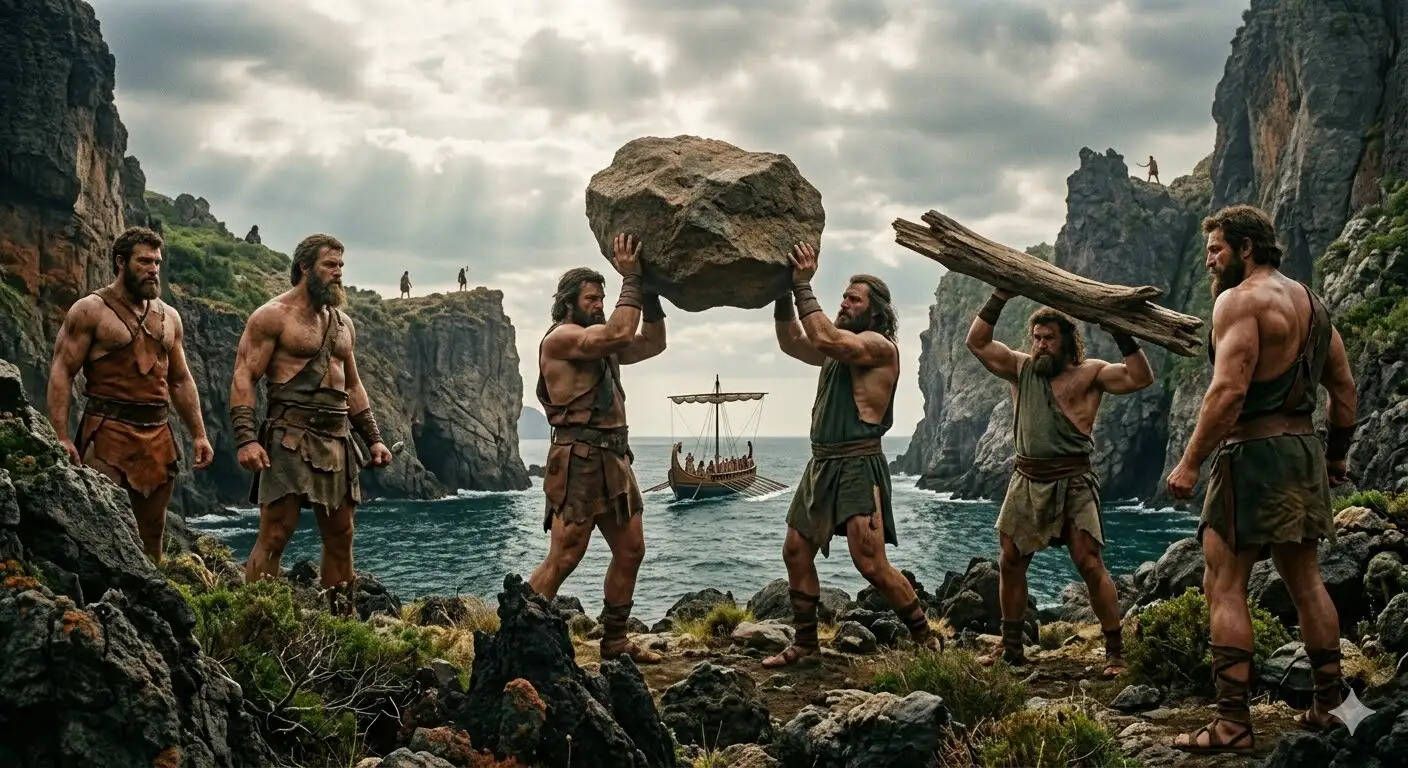
Among the many monsters and dangers Odysseus faces on his ten-year journey home in Homer's epic, few are as brutal — or as briefly told — as his encounter with the Laestrygonians. And thanks to Christopher Nolan's big-screen adaptation, this obscure chapter of ancient mythology is about to become one of the most talked-about sequences of 2026.
Who the Laestrygonians Are in Homer's Original Text
In Homer's Odyssey, the Laestrygonians are a race of giants believed to be descended from Poseidon, encountered by Odysseus and his crew shortly after their escape from the Cyclops Polyphemus. Unlike the more famous Cyclops episode, the Laestrygonians attack almost without warning. As Odysseus's fleet sails into what looks like a safe, sheltered harbor, the giants reveal themselves as savage cannibals, hurling massive boulders down from the cliffs to smash the ships before wading in to spear and eat the fleeing sailors like fish.
The devastation is swift and almost total. Of Odysseus's twelve ships, eleven are destroyed in the harbor, along with nearly their entire crews — only Odysseus's own ship, which he had cautiously kept outside the harbor, survives. It's one of the single largest losses of life in the entire poem, condensed into a startlingly short passage, and it marks the moment Odysseus's expedition shifts from a fighting force into a party of survivors.
Why the Laestrygonians Matter to the Story
Beyond the immediate carnage, the episode carries real narrative weight. It's the point where Odysseus loses the bulk of his men and ships in one blow, setting up the far smaller, more vulnerable crew that will face Circe, the Sirens, Scylla and Charybdis, and the rest of the journey home. Thematically, the Laestrygonians also reinforce one of the Odyssey's recurring warnings: hospitality, or its absence, defines whether a stranger's shore is safe. Where other communities in the poem test Odysseus with generosity or trickery, the Laestrygonians offer only violence, standing as one of the story's clearest examples of hospitality's dark opposite.
Their Role in Christopher Nolan's Film
Christopher Nolan's The Odyssey, starring Matt Damon as Odysseus, released on July 17, 2026, and marks the director's first film since Oppenheimer. Footage revealed at CinemaCon and in later trailers confirmed the Laestrygonians as one of the film's major set pieces, alongside other mythological threats like Charybdis.
In interviews, Nolan has described wanting to emphasize the sheer brutality and unfamiliar sophistication of the giants as warriors, noting their weapons and armor represent a level of danger Odysseus has never encountered. To bring the giants to life, the production reportedly relied on forced-perspective camera techniques and wirework rather than leaning entirely on digital effects, physically flinging performers playing Odysseus's crew to sell the scale of the giants against the human sailors.
Nolan has also spoken more broadly about taking creative liberties with the source material throughout the film, a common and expected part of adapting a poem that itself descended from a fluid oral storytelling tradition, reshaped over centuries before it was ever written down.
What to Expect
For audiences unfamiliar with the Odyssey's lesser-known chapters, the Laestrygonians sequence is likely to land as one of the film's most visceral and unexpected moments — a reminder that Homer's world contained horrors just as vivid as the Cyclops or the Sirens, even if history remembered them less.
