.jpg)
Muscle Memory: Why Your Body Remembers What Your Mind Forgets
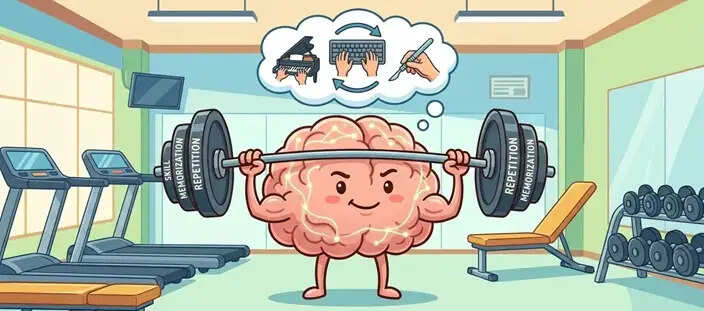
Ask someone what "muscle memory" means, and they'll probably describe riding a bike years after they last touched one, or fingers finding piano keys without conscious thought. That's real — but it turns out the phrase describes two genuinely different phenomena, one happening in your brain and one happening inside the muscle fibers themselves.
The Skill You Never Forget
The more familiar type of muscle memory has almost nothing to do with muscles at all. It's a function of the nervous system. When you repeat a movement enough times — a golf swing, a guitar chord, typing on a keyboard — your brain builds and reinforces a specific pathway between neurons dedicated to that exact sequence of motion. Over time, that pathway becomes so efficient that the movement shifts from something you have to think about into something your body executes automatically, freeing up conscious attention for everything else.
This is why skills like swimming or driving a car tend to stick for decades, even during long stretches without practice, while purely academic knowledge fades much faster. The movement isn't stored as a memory in the traditional sense — it's encoded as a procedure, and procedural memory is remarkably durable once it's built.
The Muscle's Own Version of Memory
The second, more surprising type of muscle memory happens at the cellular level, inside the muscle tissue itself — and it's still an active area of scientific research. When a muscle grows through training, its fibers don't just get bigger; they also recruit additional nuclei, the cell's control centers, through specialized stem cells called satellite cells. For a long time, researchers believed these nuclei were lost again if the muscle later shrank from inactivity.
More recent research has proposed something different: that at least some of these added nuclei may stick around even after a muscle shrinks back down from lost training, essentially leaving behind a kind of cellular scaffolding. The theory, sometimes called myonuclear permanence, suggests this could explain why previously trained muscle tends to regrow faster the second time around — as if the tissue "remembers" its former size and rebuilds toward it more efficiently.
It's worth being honest about the uncertainty here: this cellular theory is still genuinely debated among exercise scientists. Much of the strongest evidence for permanent nuclei retention comes from animal studies, and human research has had a harder time isolating how much of the "faster regrowth" effect comes from retained nuclei specifically, versus other factors — including the neurological motor-learning pathways described above, which also make lifting technique and coordination snap back quickly after time off.
Why It Matters Beyond the Gym
Muscle memory has real practical relevance well beyond athletic performance. It's part of why physical therapists emphasize early, consistent movement after an injury, and why regaining strength after a long break — whether from illness, pregnancy, or simply a demanding stretch of life — often happens faster than building that same strength did the very first time. It also plays into ongoing conversations in professional sports around anti-doping policy, since some researchers have raised questions about whether muscle built during a period of banned substance use could leave a lasting cellular advantage long after someone stops.
Whether the explanation ultimately traces back to neurons, nuclei, or some combination of both, the underlying experience is one nearly everyone who's returned to an old physical skill or a lapsed fitness routine recognizes instinctively: the body seems to remember what it once knew, and getting it back rarely takes as long as building it did the first time.
